
The Digital Mirror: Navigating the Complex Effects of Social Media on Modern Youth
The Digital Mirror: Navigating the Complex Effects of Social Media on Modern Youth
In the current landscape of 2026, the question is no longer if social media affects teenagers, but how profoundly it reshapes their development. With nearly 95% of adolescents aged 10–17 reporting "constant" social media use, the digital environment has become the primary theater for social and identity formation.
While these platforms offer unprecedented avenues for connection and creativity, recent data from 2024 to 2026 suggests a sharpening divide between casual use and problematic engagement.
1. The Developing Brain and the "Reward Loop"
Adolescence is a critical window for neurological development, particularly in the prefrontal cortex (responsible for impulse control) and the amygdala (responsible for emotional processing).
Recent neuroimaging studies (2025) have highlighted that habitual social media checking—defined as checking feeds more than 15 times a day—triggers a hypersensitivity to social rewards. This creates a physiological "reward loop" similar to that seen in gambling.
Dopamine Spikes: The intermittent reinforcement of "likes" and notifications conditions the brain to seek constant external validation.
Impulse Control: Excessive use is now being linked to diminished executive functioning, making it harder for teens to regulate their focus and resist immediate digital gratification.
2. Mental Health: The Shift in Teen Perspective
According to a landmark Pew Research Center report (late 2024/early 2025), a significant shift is occurring in how teenagers perceive their own digital lives.
Growing Concern: 48% of teens now believe social media has a "mostly negative" effect on people their age, up from 32% in 2022.
The Gender Divide: The impact is not uniform. Teen girls are statistically more likely to report that social media negatively affects their self-confidence and body image.
The "Three-Hour" Threshold: Multiple studies, including those from JAMA Psychiatry, consistently show that spending more than three hours per day on social media is associated with double the risk of experiencing symptoms of depression and anxiety.
3. Physical Health and Sleep Disruption
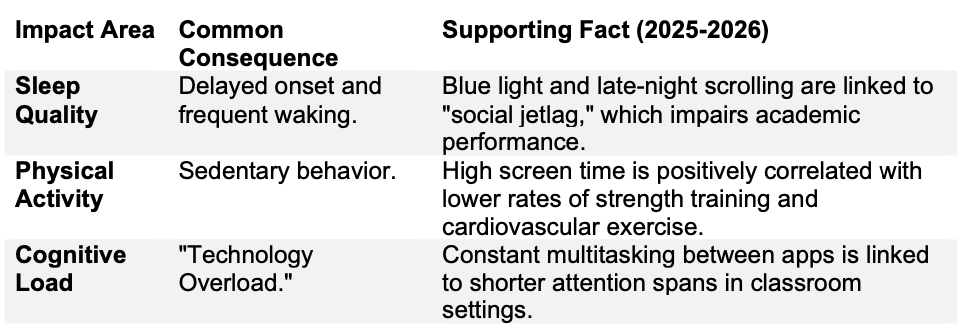
The effects of social media extend beyond the psychological into the biological. The displacement of physical activity and the disruption of sleep cycles are among the most documented harms.
4. The Positive Counter-Narrative
It is essential to acknowledge that for many, social media serves as a vital lifeline. For marginalized youth—including LGBTQ+ and neurodivergent teenagers—digital communities often provide a level of support and acceptance that may be unavailable in their immediate physical environment.
"Social media is not a monolith. For a teen finding a community for a niche interest or a support group for a rare medical condition, the 'digital mirror' provides a sense of belonging that is protective against isolation." — Clinical Perspective, 2025.
Looking Ahead: A New Standard of Safety
As of early 2026, the industry is moving toward greater accountability. The launch of the Safe Online Standards (S.O.S.) initiative—where platforms like Instagram, TikTok, and YouTube have agreed to independent mental health ratings—marks a turning point.
For parents and educators, the goal is shifting from "total restriction" to "digital literacy." By understanding the neurological and psychological levers at play, we can better equip the next generation to navigate the digital world with resilience rather than being consumed by it.
Part 1: Digital Wellness Tips for Parents
The goal for 2026 is "Agency over Restriction." Rather than strictly policing time, focus on the quality of engagement and the preservation of biological needs like sleep.
The "60-Minute Sunset" Rule: Ensure all devices are out of bedrooms and off at least one hour before sleep. This prevents blue light from suppressing melatonin and stops the "revenge bedtime procrastination" common in teens.
Establish "No-Tech Islands": Designate specific times and places—such as the dinner table, car rides under 15 minutes, or Sunday mornings—as phone-free zones for the entire family, including adults.
The "Post-Check" Discussion: Instead of asking "How long were you on TikTok?", ask "Did anything you saw today make you feel annoyed or insecure?" This shifts the focus to emotional regulation.
Co-Management of Privacy: Regularly review app permissions together. Ensure "Significant Locations" are turned off and that "Contact Sharing" is restricted to prevent data harvesting by third-party advertisers.
Part 2: School Social Media Policy Template
For educators and administrators, a modern policy must bridge the gap between professional communication and student safety. Below is a professional framework you can adapt.
I. Purpose & Scope
The primary goal of our social media presence is to foster community engagement and celebrate student achievement while maintaining a secure, FERPA-compliant digital environment.
II. Professional Conduct (Staff)
Separation of Accounts: Staff must maintain separate personal and professional accounts. "Friending" current students on personal profiles is strictly prohibited.
The "Classroom Mirror" Standard: Any content posted to a school-affiliated account must be appropriate for a physical classroom setting.
Supervisory Access: All official school accounts (departmental, athletic, etc.) must grant administrative "designee" rights to the Principal or IT Director.
III. Student Privacy & Consent
Media Release Opt-Out: No student photos or videos may be posted if a "Media Refusal" form is on file.
Identification Limits: Use only first names and last initials. Never tag students in public-facing posts without explicit, documented permission for that specific event.
Information Security: Sensitive data (grades, ID numbers, or schedules) must never be visible in the background of any shared media.
IV. Community Management
The 24-Hour Feedback Loop: Professional accounts should aim to address concerns or questions within 24 hours.
Comment Moderation: Harassment, vulgarity, or "doxxing" (sharing private info) will result in immediate comment removal and, if necessary, a report to the SOS (Safe Online Standards) board.
This blog is for informational purposes only and does not constitute medical advice. If you have concerns about your child's mental health or substance use, please consult a qualified healthcare provider.
