Farrah Laviolette, MD Farrah Laviolette, MD

Talking to your children about drugs and alcohol

The Conversation That Can't Wait — Dr. Farrah Laviolette, MD
Child & Adolescent Psychiatry — Dr. Farrah Laviolette, MD
For Parents
Parenting & Prevention

The Conversation That Can't Wait

A psychiatrist's honest guide to talking with your children about drugs and alcohol — before someone else does.

Dr. Farrah Laviolette, MD 14-min read

In my years of clinical practice, I have sat across from hundreds of parents who tell me some version of the same thing: "I always meant to have that talk. I just thought we had more time."

Here is what I need you to hear: the research is unambiguous. Children who have ongoing, open conversations with their parents about drugs and alcohol are significantly less likely to use them — and more likely to seek help when they encounter pressure to do so. The conversation is not a single dramatic event. It is a relationship. And it starts much earlier than most parents expect.

This post is a practical, evidence-informed guide. I want to give you the language, the timing, and the mindset to make these conversations feel natural rather than terrifying — for both of you.

"You do not need a perfect script. You need presence, consistency, and the courage to begin — even imperfectly."


Step-by-Step Framework

Step 01

Start Earlier Than You Think

Most parents imagine this conversation belongs to the teenage years. In reality, children as young as eight or nine are already encountering messaging about alcohol — from television, sports sponsorships, and family gatherings. By age eleven, many have been offered a substance by a peer for the first time.

For young children (ages 5–9), keep it simple and body-based: "Some things can hurt your growing brain and body, even when adults say they're okay for grown-ups." Normalize the topic without dramatizing it. The goal at this age is familiarity, not fear.

Clinical tip: A relaxed, low-stakes moment — a car ride, a walk, a quiet evening — is almost always more effective than a formal sit-down talk.
Step 02

Ask Before You Tell

One of the most common mistakes parents make is leading with information when they should be leading with curiosity. Before launching into a lecture, ask your child what they already know. "Have you ever heard kids at school talking about drinking or smoking? What do they say about it?"

This approach does three important things: it tells you what misconceptions to address, it signals that you are a safe person to talk to, and it gives your child ownership over the conversation. Children who feel lectured tend to tune out. Children who feel heard tend to stay engaged.

Clinical tip: Resist the urge to correct immediately. Listen fully first. Reflect back what you heard before you respond.
Step 03

Be Honest About Your Own History

This is the step that makes most parents uncomfortable, and I understand why. But consider this: if you tell your teenager you never drank or experimented and they later learn otherwise, you lose credibility on everything else. And credibility is your most valuable parenting asset.

You do not need to share every detail of your past. You can say, "I made some choices when I was young that I wouldn't make today, and here is what I learned." Authenticity builds trust. Trust keeps the door open when it matters most.

Clinical tip: Emphasize consequences and perspective rather than confession. The goal is relatability, not absolution.
Step 04

Teach Decision-Making, Not Just Rules

Rules without reasoning create children who only comply when someone is watching. Instead, help your child build an internal framework for navigating pressure. Role-play scenarios: "What would you do if a friend offered you something at a party and everyone was watching?"

Practice exit phrases together. Give them permission — even an explicit code word or text — to blame you when they need an out. "My mom would lose it if she found out" is a socially acceptable exit for many teens, and offering yourself as that excuse is a gift, not a weakness.

Clinical tip: Practice these scenarios more than once. One conversation rarely sticks. Return to it at different ages with updated nuance.
Step 05

Address the Specific Risks for Their Age Group

The developing brain is not fully formed until approximately age 25. This is not a figure of speech — the prefrontal cortex, responsible for judgment, impulse control, and long-term thinking, is the last region to mature. Alcohol and cannabis, in particular, have documented effects on adolescent brain development that are not observed in adult brains.

For teens, share this honestly: "I'm not saying this to scare you. I'm telling you because the risks are genuinely higher for your brain than they would be for mine. The science is clear on this." Most adolescents respond better to facts than to moralizing.

Clinical tip: Avoid exaggerating or making false claims. When teens fact-check and find you overstated a risk, it can undermine your credibility entirely.
Step 06

Keep the Door Open — Always

Perhaps the most important thing you can do is communicate, repeatedly and clearly, that your child will not lose your love or your support if they make a mistake or need help. Fear of parental reaction is one of the top reasons adolescents do not disclose substance use until it has escalated into a crisis.

"I would rather you call me from a party at 2am than try to find your own way home. No questions asked that night. We can talk in the morning." Mean this. Honor it if the call comes.

Clinical tip: The consequence conversation is separate from the safety conversation. They do not happen at the same time.
Step 07

Know When to Seek Professional Help

These conversations are preventive for most families — but they are also diagnostic. Sometimes, through talking, you will sense something more is going on: persistent withdrawal, changes in friend groups, declining school performance, secretiveness that feels qualitatively different.

Early intervention is almost always more effective than delayed intervention. A pediatrician, school counselor, or child and adolescent psychiatrist can help you assess what you're seeing — and help your child access support before a pattern becomes a dependency.

Clinical tip: Trust your instincts. You know your child. Seeking an evaluation is not an overreaction. It is good parenting.

Warning Signs to Watch For in Adolescents

  • Sudden change in friend group with reluctance to introduce new peers
  • Unexplained drop in grades or school attendance
  • Increased secrecy around phone, whereabouts, or activities
  • Bloodshot eyes, dilated or constricted pupils
  • Significant changes in sleep patterns or appetite
  • Money or valuables going missing from the home
  • Mood swings, irritability, or unusual euphoria
  • Loss of interest in hobbies or activities they previously loved
  • Finding drug paraphernalia or unfamiliar substances
  • Strong or unusual smells on clothing or breath

None of these signs in isolation is definitive. But a cluster of them, or a marked shift from your child's baseline, is worth a conversation with a professional.

A Final Word to Parents

You do not need to be perfect at this. You do not need a medical degree or a rehearsed script. What your child needs is a parent who shows up consistently, speaks honestly, and makes it clear that no matter what happens, they are not alone. That relationship — that ongoing, imperfect, courageous conversation — is the single most powerful protective factor in your child's life.

Start today. Start simply. Start with a question.


This blog is for informational purposes only and does not constitute medical advice. If you have concerns about your child's mental health or substance use, please consult a qualified healthcare provider.
Read More
Farrah Laviolette, MD Farrah Laviolette, MD

The Power of "Internalizing Goodness": Why Your Kids (and Employees) Are More Capable Than You Think

In a recent episode of Simon Sinek’s A Bit of Optimism, Dr. Becky Kennedy—known to millions as the "Parenting Whisperer"—dropped some truth bombs that do more than just improve your 5:00 PM routine. They actually reshape how we understand human development and leadership.

The core takeaway? Whether you are dealing with a toddler having a meltdown over a blue bowl or an employee missing a deadline, people usually have more internal resources than we give them credit for. We just have to stop "fixing" and start "building."

1. Connection Before Correction

Dr. Becky’s most famous principle is that every child is "Good Inside." This doesn't mean their behavior is always good, but their core identity is.

  • The Advice: When your child acts out, they aren't "being a brat"; they are having a hard time. Before you jump to a timeout or a lecture, connect with them.

  • The Application: Use the phrase, "I can see you're having a really hard time right now." This validates their experience without approving of the bad behavior. It keeps the relationship intact, so they are actually capable of learning.

2. The Power of "Repair"

One of the most liberating points in the podcast was the idea that you don't have to be a perfect parent (or boss) to raise a healthy human. You just have to be good at Repair.

  • The Advice: A "Repair" is the act of returning to a moment of disconnection, acknowledging what happened, and taking responsibility for your part.

  • The Application: If you lost your cool and yelled, go back later and say: "I'm sorry I yelled earlier. It wasn't your fault that I lost my temper. I’m working on staying calm even when I’m frustrated." This teaches your child that mistakes are fixable.

3. Resilience vs. Happiness

Modern parenting often falls into the trap of trying to make kids "happy" all the time. Dr. Becky argues we should be building resilience instead.

  • The Advice: Stop trying to solve every struggle. If they can't build a LEGO tower, don't build it for them.

  • The Application: Sit with them in the frustration. Say, "This is hard. You’re doing something really tricky." By not "fixing" it, you are showing them you trust their ability to handle struggle.

A Psychiatric Perspective: Why This Works

From a clinical and neurobiological standpoint, Dr. Becky’s approach aligns with Attachment Theory and Self-Determination Theory.

The Window of Tolerance

When a child (or employee) is overwhelmed, they leave their "window of tolerance." In this state, the prefrontal cortex—the part of the brain responsible for logic and problem-solving—essentially goes offline.

By focusing on Connection First, Dr. Becky is essentially helping the individual's nervous system regulate. Once they feel safe and "seen," the brain can re-engage its logical centers.

Internal vs. External Locus of Control

Traditional "reward and punishment" systems (like sticker charts) focus on External Locus of Control. You do the thing to get the prize or avoid the pain.

Psychiatrically, this is brittle. Dr. Becky’s method builds an Internal Locus of Control. By validating a child’s internal state, you help them build a "sturdy" sense of self. They learn to regulate because it feels right internally, not because they are afraid of a "timeout." This leads to long-term emotional intelligence rather than short-term compliance.

The Bottom Line

Dr. Becky’s appearance on A Bit of Optimism reminds us that leading a family and leading a team are the same skill: Seeing the person beneath the performance. When we assume people are "Good Inside" and capable of handling hard things, they usually rise to the occasion.

Try it today: The next time someone "fails" in front of you, ask yourself: "How can I connect with them before I try to fix the problem?"

This blog is for informational purposes only and does not constitute medical advice. If you have concerns about your child's mental health or substance use, please consult a qualified healthcare provider.

Read More
Farrah Laviolette, MD Farrah Laviolette, MD

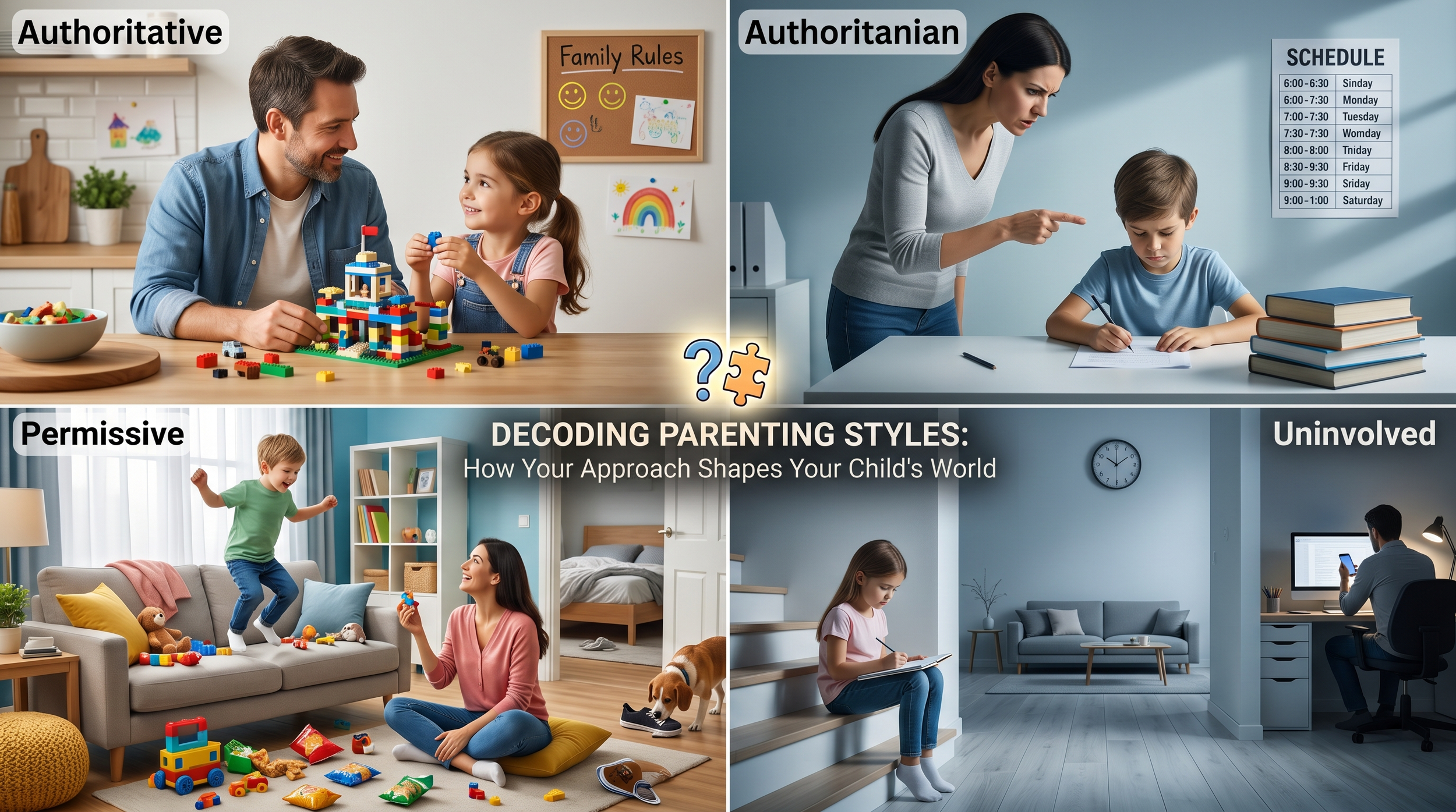
Decoding Parenting Styles: How Your Approach Shapes Your Child's World

The Four Parenting Styles – And Why They Matter

Child Development & Family Psychology

The Four Parenting Styles —
And Why They Matter

From the first steps to the teenage years, the way we parent shapes who our children become. Here's what the research really says.

Based on the research framework of Diana Baumrind  ·  Updated with findings through 2023

The journey of parenting is one of the most complex and rewarding experiences a person can undertake. From the moment a child is born, parents begin to establish a unique way of interacting, guiding, and disciplining — what psychologists call a "parenting style."

Understanding these styles isn't about finding a "perfect" approach or judging yourself harshly. It's about self-reflection: recognizing the potential impact of your choices and adapting to meet your child's evolving needs at every stage.

The most widely recognized framework comes from developmental psychologist Diana Baumrind, whose groundbreaking research in the 1960s identified two core dimensions of parenting: responsiveness — warmth, emotional connection, and support — and demandingness — expectations, discipline, and control.

The combination of these two axes produces four distinct styles, each with measurably different outcomes for children and adolescents across every stage of development.

A Framework Built on Two Dimensions

Where a parent falls on the responsiveness and demandingness axes determines their parenting style — and research shows these styles have profound, lasting effects on children's emotional health, academic achievement, and social development. The authoritative quadrant (highlighted) is consistently linked to the best outcomes across cultures and age groups.

High demand + High responseAuthoritative
High demand + Low responseAuthoritarian
Low demand + High responsePermissive
Low demand + Low responseUninvolved

↑ Demandingness     Responsiveness →

01

Authoritative Parenting

The "Just Right" Approach

Most Beneficial

Authoritative parents set clear expectations and rules, explain the reasoning behind them, and encourage open communication. They are warm and supportive, but also firm when necessary. Discipline is focused on teaching, not just punishing.

More self-reliant — they learn to make decisions and take responsibility
Higher academic achievement and stronger problem-solving skills
Greater emotional regulation and stress management
Higher self-esteem and social competence in peer relationships
Latest ResearchA 2022 meta-analysis in Child Development Perspectives reaffirmed the strong link between authoritative parenting and positive outcomes across cultures. A study in the Journal of Youth and Adolescence found that high parental warmth combined with reasonable control predicted significantly greater adolescent resilience, with lower rates of anxiety, depression, and antisocial behavior.
02

Authoritarian Parenting

The "My Way or the Highway" Approach

Use with Caution

Authoritarian parents impose strict rules and expect unquestioning obedience. They often use punishment rather than discussion, and offer little warmth or emotional support. Communication is typically one-way — from parent to child.

Lower self-esteem — children feel their opinions aren't valued
Higher rates of anxiety and depression due to fear of failure
May exhibit more aggressive behavior as a learned response to frustration
Difficulty with independent decision-making and critical thinking
Latest ResearchA 2021 study in the Journal of Family Psychology linked authoritarian parenting with increased risk of anxiety, depression, and poorer academic performance in adolescence. A cross-European survey found that teens who perceived their parents as highly authoritarian reported significantly higher levels of externalizing behaviors.
03

Permissive Parenting

The "Friend First" Approach

Warm but Unstructured

Permissive parents are very warm and nurturing, but set few rules or expectations. They are often reluctant to discipline, may act more like a friend than a parent, and prioritize keeping the peace over consistency and structure.

Difficulty with self-control — they never learned to recognize boundaries
Poor academic performance due to absence of expectations
Higher rates of impulsivity and risky behavior without clear limits
Struggles with entitlement and understanding consequences for others
Latest ResearchA 2020 study in Developmental Psychology found that adolescents with permissive parents were more likely to engage in risk-taking behaviors — including substance use — due to a lack of parental monitoring and clear boundaries. Research also suggests a correlation with higher rates of childhood obesity.
04

Uninvolved Parenting

The "Hands-Off" Approach

Most Harmful

Uninvolved parents provide little to no guidance, emotional support, or supervision. They are often disengaged from their child's life — whether due to personal struggles like mental health issues or substance abuse, or simply a lack of interest.

Significant emotional and behavioral problems — children may feel abandoned and unloved
Higher risk of depression, anxiety, and suicidal ideation
Increased likelihood of substance abuse, delinquency, and early sexual activity
Lasting difficulty forming healthy relationships and secure attachments
Latest ResearchA 2023 CDC report indicated that children experiencing neglect are at significantly higher risk for long-term health problems, poor academic outcomes, and justice system involvement. The trauma of neglect has measurable effects on brain development and the body's long-term stress regulation systems.

Beyond the Categories: Nuance Matters

No family fits neatly into one box — and that's perfectly normal.

No parent fits one box

Most parents exhibit elements of different styles depending on the situation, the child's age, and their own stress levels. Flexibility is healthy, not inconsistent.

Culture shapes interpretation

What appears "authoritarian" in one cultural context may be experienced as protective and guiding in another. Context and community always matter.

Every child is different

A child's inherent temperament influences how they respond to parenting approaches. What works beautifully for one child may not work for a sibling.

Aim for intention, not perfection

The goal is to make conscious, thoughtful choices — not to achieve a flawless standard that no real parent has ever reached.

Moving Toward an Authoritative Approach

Research strongly supports the authoritative style. Here are six practical steps to get there.

1
Be warm and responsive

Show affection, listen actively, and validate your child's feelings. Emotional connection is the foundation of everything else.

2
Set clear, consistent rules

Children thrive on predictability. Knowing what to expect creates a sense of safety — not restriction.

3
Explain the "why"

Help your child understand the reasoning behind rules. This fosters moral development and critical thinking, not just compliance.

4
Encourage independence

Offer choices and allow natural consequences within safe limits. Children learn to own their decisions when given the chance.

5
Use positive discipline

Focus on teaching and guiding. Logical consequences and collaborative problem-solving outperform punishment-only approaches.

6
Model what you want to see

Children learn far more from observation than instruction. How you handle frustration, conflict, and kindness speaks louder than any rule.

"The influence of parenting is profound and long-lasting — but it's never too late to be intentional about the kind of parent you want to be."

By understanding the different styles and their real impacts, parents can strive to create an environment that raises confident, capable, and well-adjusted individuals. It's a continuous learning process — and one that yields the greatest rewards.

This blog post is for informational purposes only and does not constitute medical or psychological advice.
If you have concerns about your child's mental health or wellbeing, please consult a qualified healthcare provider.

Read More
Farrah Laviolette, MD Farrah Laviolette, MD

Signs Your Child May Have ADHD: What Every Parent Should Know

Signs Your Child May Have ADHD — Dr. Farrah Laviolette, MD
Child & Adolescent Psychiatry

Signs Your Child May Have ADHD: What Every Parent Should Know

As a child psychiatrist, one of the most common reasons families walk through my door is a concern about attention. Parents often tell me: "He just can't focus," or "She's constantly on the move and I don't know why." ADHD is real, it's manageable — and the earlier we recognize it, the better.

Attention Deficit Hyperactivity Disorder is not a matter of willpower, parenting style, or intelligence. It is a neurodevelopmental condition rooted in differences in brain development — particularly in areas governing impulse control, sustained attention, and executive function. And it is far more common than many parents realize.

How common is ADHD? The numbers may surprise you

ADHD is one of the most prevalent childhood neurodevelopmental disorders in the world. Here is what the latest data tells us — drawn primarily from the CDC's 2022 National Survey of Children's Health and recent peer-reviewed research.

11.4%
of U.S. children ages 3–17 have been diagnosed with ADHD
CDC, 2022
7.1M
children in the U.S. currently living with an ADHD diagnosis
CDC, 2022
3.1%
of adults worldwide estimated to have ADHD
Global meta-analysis
42%
increase in child ADHD diagnoses between 2003 and 2011
NIMH / NSCH

To put this in perspective: if you have 25 children in your child's classroom, statistically, two or three of them have ADHD. It is not rare. It is not new. What has changed is our ability — and willingness — to recognize it.

Who is most affected?

ADHD does not affect all children equally. The data reveals meaningful differences by age, sex, and geography that are worth understanding — not because biology is destiny, but because awareness shapes who gets help and who gets missed.

Diagnosed ADHD rates by group — U.S. children (CDC, 2022)
Boys
15%
Girls
8%
Ages 12–17
13%+
Ages 5–11
~9%
Louisiana (highest)
16.5%
State rates range from 6% to 16% nationally, reflecting differences in awareness, access to care, and diagnostic practices.

Boys are diagnosed at nearly twice the rate of girls — but this does not mean girls have ADHD less often. It means they present differently, and the system is slower to catch them. More on that below.

What about co-occurring conditions?

One of the most important things I tell families is this: ADHD rarely travels alone. The 2022 data shows that roughly half of children with ADHD have two or more co-occurring conditions. The most common are behavioral or conduct problems (44%), anxiety (39%), and learning disabilities (37%). Understanding the full picture is essential to getting the right support.

A note about the treatment gap: Despite the prevalence of ADHD, nearly 30% of children with a current diagnosis receive no treatment at all — no medication, no behavioral therapy. Access to care, insurance coverage, and provider shortages all play a role. If your child has been diagnosed but is not receiving support, please advocate for them.

The three presentations of ADHD

Clinically, we recognize three subtypes. Some children are predominantly inattentive, some are predominantly hyperactive-impulsive, and many have a combined presentation. Knowing which pattern fits your child matters — it shapes how we approach treatment.

Inattentive signs
Hyperactive / impulsive signs
Behavioral & emotional signs
Inattentive · 01

Difficulty sustaining focus

Struggles to stay on task during homework, reading, or conversations — especially when the activity feels boring or repetitive.

Inattentive · 02

Frequent careless mistakes

Not due to lack of effort — their brain shifts attention before the task is complete, leading to errors that seem avoidable.

Inattentive · 03

Easily distracted

Even minor background sounds, visual stimuli, or unrelated thoughts pull their attention away from what matters in the moment.

Inattentive · 04

Forgetfulness in daily tasks

Routinely forgets homework, chores, appointments, or personal belongings — this is neurological, not deliberate carelessness.

Hyperactive · 01

Excessive movement or restlessness

Fidgets constantly, leaves their seat, climbs on furniture — especially in situations where staying still is expected.

Hyperactive · 02

Talks excessively

Has difficulty staying quiet in class or in conversation, often interrupting others or blurting answers before a question finishes.

Hyperactive · 03

Acts before thinking

Grabs things, runs into traffic, says things without filtering — impulse control takes longer to develop in children with ADHD.

Hyperactive · 04

Difficulty waiting their turn

Becomes visibly frustrated when waiting in line or during games — the brain's braking system is slower to engage.

Behavioral · 01

Emotional dysregulation

Intense reactions to frustration, rejection, or failure. Low frustration tolerance is one of the most underrecognized ADHD symptoms.

Behavioral · 02

Inconsistent performance

Does brilliantly on things they love, then seems to "shut down" on tasks they don't. This inconsistency is a hallmark, not an attitude problem.

Behavioral · 03

Trouble with organization & planning

Cannot independently manage multi-step tasks, backpacks are chaotic, deadlines are missed — executive function lags are central to ADHD.

Behavioral · 04

Social difficulties

May interrupt peers, miss social cues, or struggle with friendship dynamics — not due to a lack of caring, but challenges in self-monitoring.

A note about girls and ADHD: Girls with ADHD are far more likely to be missed. They often present with the inattentive subtype — daydreaming, quietly disorganized, anxious — without the disruptive behaviors that trigger early referrals. CDC data shows girls are diagnosed at roughly half the rate of boys (8% vs. 15%), yet clinicians believe true prevalence is much closer than that gap suggests. By the time many girls are diagnosed, they've spent years masking, and their self-esteem has taken a hit. If your daughter fits this picture, trust your instincts and seek an evaluation.

When should you seek an evaluation?

I encourage parents to pursue a professional evaluation if: the behaviors have been present for at least six months; they appear in more than one setting (home and school, not just one); and they are causing real functional difficulty — academic underperformance, social struggles, or emotional distress. The median age of diagnosis for ADHD is around 6 years, though more severe presentations are often caught earlier, sometimes as young as 4.

A diagnosis requires a comprehensive evaluation — not just a checklist. In my clinic, this includes a clinical interview with the child and family, standardized rating scales completed by parents and teachers, a review of academic history, and ruling out other conditions that can mimic ADHD, such as anxiety, learning disabilities, sleep disorders, or trauma responses.

What a diagnosis means — and doesn't mean

Receiving an ADHD diagnosis is not a label that limits your child. In my experience, most families feel a sense of relief when they finally have answers. It explains so much of the struggle — and opens the door to real, evidence-based support.

Treatment may include behavioral strategies, school accommodations, parent coaching, therapy, and in many cases, medication. Stimulant medications — when appropriate — have some of the strongest evidence of any intervention in child psychiatry. But treatment is always individualized. No single path fits every child.

The most important thing I tell families: your child is not broken. Their brain works differently — and with the right support, children with ADHD go on to lead rich, meaningful, and often remarkably creative lives.

Sources: CDC National Survey of Children's Health (2022); NCHS Data Brief No. 499 (March 2024); NIMH Statistics on ADHD; Journal of Clinical Child & Adolescent Psychology (Danielson et al., 2024); ADHDAdvisor.org prevalence review (2024).
Read More
Farrah Laviolette, MD Farrah Laviolette, MD

The Digital Mirror: Navigating the Complex Effects of Social Media on Modern Youth

The Digital Mirror: Navigating the Complex Effects of Social Media on Modern Youth

In the current landscape of 2026, the question is no longer if social media affects teenagers, but how profoundly it reshapes their development. With nearly 95% of adolescents aged 10–17 reporting "constant" social media use, the digital environment has become the primary theater for social and identity formation.

While these platforms offer unprecedented avenues for connection and creativity, recent data from 2024 to 2026 suggests a sharpening divide between casual use and problematic engagement.

1. The Developing Brain and the "Reward Loop"

Adolescence is a critical window for neurological development, particularly in the prefrontal cortex (responsible for impulse control) and the amygdala (responsible for emotional processing).

Recent neuroimaging studies (2025) have highlighted that habitual social media checking—defined as checking feeds more than 15 times a day—triggers a hypersensitivity to social rewards. This creates a physiological "reward loop" similar to that seen in gambling.

  • Dopamine Spikes: The intermittent reinforcement of "likes" and notifications conditions the brain to seek constant external validation.

  • Impulse Control: Excessive use is now being linked to diminished executive functioning, making it harder for teens to regulate their focus and resist immediate digital gratification.


2. Mental Health: The Shift in Teen Perspective

According to a landmark Pew Research Center report (late 2024/early 2025), a significant shift is occurring in how teenagers perceive their own digital lives.

  • Growing Concern: 48% of teens now believe social media has a "mostly negative" effect on people their age, up from 32% in 2022.

  • The Gender Divide: The impact is not uniform. Teen girls are statistically more likely to report that social media negatively affects their self-confidence and body image.

  • The "Three-Hour" Threshold: Multiple studies, including those from JAMA Psychiatry, consistently show that spending more than three hours per day on social media is associated with double the risk of experiencing symptoms of depression and anxiety.

3. Physical Health and Sleep Disruption

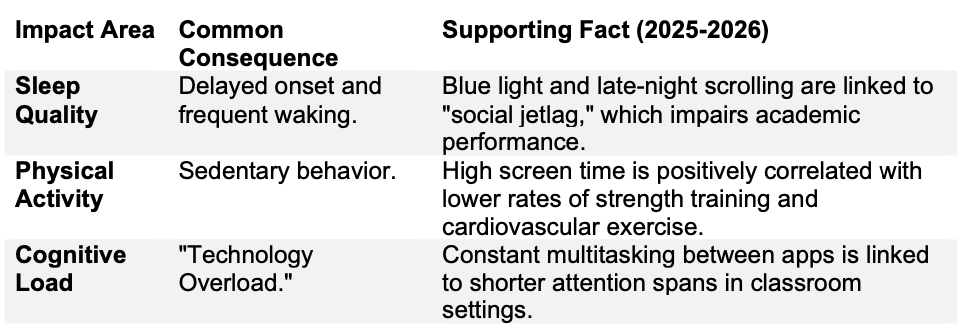
The effects of social media extend beyond the psychological into the biological. The displacement of physical activity and the disruption of sleep cycles are among the most documented harms.

Impact Area

Common Consequence

Supporting Fact (2025-2026)

Sleep Quality

Delayed onset and frequent waking.

Blue light and late-night scrolling are linked to "social jetlag," which impairs academic performance.

Physical Activity

Sedentary behavior.

High screen time is positively correlated with lower rates of strength training and cardiovascular exercise.

Cognitive Load

"Technology Overload."

Constant multitasking between apps is linked to shorter attention spans in classroom settings.


4. The Positive Counter-Narrative

It is essential to acknowledge that for many, social media serves as a vital lifeline. For marginalized youth—including LGBTQ+ and neurodivergent teenagers—digital communities often provide a level of support and acceptance that may be unavailable in their immediate physical environment.

"Social media is not a monolith. For a teen finding a community for a niche interest or a support group for a rare medical condition, the 'digital mirror' provides a sense of belonging that is protective against isolation." — Clinical Perspective, 2025.


Looking Ahead: A New Standard of Safety

As of early 2026, the industry is moving toward greater accountability. The launch of the Safe Online Standards (S.O.S.) initiative—where platforms like Instagram, TikTok, and YouTube have agreed to independent mental health ratings—marks a turning point.

For parents and educators, the goal is shifting from "total restriction" to "digital literacy." By understanding the neurological and psychological levers at play, we can better equip the next generation to navigate the digital world with resilience rather than being consumed by it.


Part 1: Digital Wellness Tips for Parents

The goal for 2026 is "Agency over Restriction." Rather than strictly policing time, focus on the quality of engagement and the preservation of biological needs like sleep.

  • The "60-Minute Sunset" Rule: Ensure all devices are out of bedrooms and off at least one hour before sleep. This prevents blue light from suppressing melatonin and stops the "revenge bedtime procrastination" common in teens.

  • Establish "No-Tech Islands": Designate specific times and places—such as the dinner table, car rides under 15 minutes, or Sunday mornings—as phone-free zones for the entire family, including adults.

  • The "Post-Check" Discussion: Instead of asking "How long were you on TikTok?", ask "Did anything you saw today make you feel annoyed or insecure?" This shifts the focus to emotional regulation.

  • Co-Management of Privacy: Regularly review app permissions together. Ensure "Significant Locations" are turned off and that "Contact Sharing" is restricted to prevent data harvesting by third-party advertisers.

Part 2: School Social Media Policy Template

For educators and administrators, a modern policy must bridge the gap between professional communication and student safety. Below is a professional framework you can adapt.

I. Purpose & Scope

The primary goal of our social media presence is to foster community engagement and celebrate student achievement while maintaining a secure, FERPA-compliant digital environment.

II. Professional Conduct (Staff)

  • Separation of Accounts: Staff must maintain separate personal and professional accounts. "Friending" current students on personal profiles is strictly prohibited.

  • The "Classroom Mirror" Standard: Any content posted to a school-affiliated account must be appropriate for a physical classroom setting.

  • Supervisory Access: All official school accounts (departmental, athletic, etc.) must grant administrative "designee" rights to the Principal or IT Director.

III. Student Privacy & Consent

  • Media Release Opt-Out: No student photos or videos may be posted if a "Media Refusal" form is on file.

  • Identification Limits: Use only first names and last initials. Never tag students in public-facing posts without explicit, documented permission for that specific event.

  • Information Security: Sensitive data (grades, ID numbers, or schedules) must never be visible in the background of any shared media.

IV. Community Management

  • The 24-Hour Feedback Loop: Professional accounts should aim to address concerns or questions within 24 hours.

  • Comment Moderation: Harassment, vulgarity, or "doxxing" (sharing private info) will result in immediate comment removal and, if necessary, a report to the SOS (Safe Online Standards) board.

The Digital Mirror: Navigating the Complex Effects of Social Media on Modern Youth

In the current landscape of 2026, the question is no longer if social media affects teenagers, but how profoundly it reshapes their development. With nearly 95% of adolescents aged 10–17 reporting "constant" social media use, the digital environment has become the primary theater for social and identity formation.

While these platforms offer unprecedented avenues for connection and creativity, recent data from 2024 to 2026 suggests a sharpening divide between casual use and problematic engagement.

1. The Developing Brain and the "Reward Loop"

Adolescence is a critical window for neurological development, particularly in the prefrontal cortex (responsible for impulse control) and the amygdala (responsible for emotional processing).

Recent neuroimaging studies (2025) have highlighted that habitual social media checking—defined as checking feeds more than 15 times a day—triggers a hypersensitivity to social rewards. This creates a physiological "reward loop" similar to that seen in gambling.

  • Dopamine Spikes: The intermittent reinforcement of "likes" and notifications conditions the brain to seek constant external validation.

  • Impulse Control: Excessive use is now being linked to diminished executive functioning, making it harder for teens to regulate their focus and resist immediate digital gratification.

2. Mental Health: The Shift in Teen Perspective

According to a landmark Pew Research Center report (late 2024/early 2025), a significant shift is occurring in how teenagers perceive their own digital lives.

  • Growing Concern: 48% of teens now believe social media has a "mostly negative" effect on people their age, up from 32% in 2022.

  • The Gender Divide: The impact is not uniform. Teen girls are statistically more likely to report that social media negatively affects their self-confidence and body image.

  • The "Three-Hour" Threshold: Multiple studies, including those from JAMA Psychiatry, consistently show that spending more than three hours per day on social media is associated with double the risk of experiencing symptoms of depression and anxiety.

3. Physical Health and Sleep Disruption

The effects of social media extend beyond the psychological into the biological. The displacement of physical activity and the disruption of sleep cycles are among the most documented harms.

4. The Positive Counter-Narrative

It is essential to acknowledge that for many, social media serves as a vital lifeline. For marginalized youth—including LGBTQ+ and neurodivergent teenagers—digital communities often provide a level of support and acceptance that may be unavailable in their immediate physical environment.

"Social media is not a monolith. For a teen finding a community for a niche interest or a support group for a rare medical condition, the 'digital mirror' provides a sense of belonging that is protective against isolation." — Clinical Perspective, 2025.

Looking Ahead: A New Standard of Safety

As of early 2026, the industry is moving toward greater accountability. The launch of the Safe Online Standards (S.O.S.) initiative—where platforms like Instagram, TikTok, and YouTube have agreed to independent mental health ratings—marks a turning point.

For parents and educators, the goal is shifting from "total restriction" to "digital literacy." By understanding the neurological and psychological levers at play, we can better equip the next generation to navigate the digital world with resilience rather than being consumed by it.

Part 1: Digital Wellness Tips for Parents

The goal for 2026 is "Agency over Restriction." Rather than strictly policing time, focus on the quality of engagement and the preservation of biological needs like sleep.

  • The "60-Minute Sunset" Rule: Ensure all devices are out of bedrooms and off at least one hour before sleep. This prevents blue light from suppressing melatonin and stops the "revenge bedtime procrastination" common in teens.

  • Establish "No-Tech Islands": Designate specific times and places—such as the dinner table, car rides under 15 minutes, or Sunday mornings—as phone-free zones for the entire family, including adults.

  • The "Post-Check" Discussion: Instead of asking "How long were you on TikTok?", ask "Did anything you saw today make you feel annoyed or insecure?" This shifts the focus to emotional regulation.

  • Co-Management of Privacy: Regularly review app permissions together. Ensure "Significant Locations" are turned off and that "Contact Sharing" is restricted to prevent data harvesting by third-party advertisers.

Part 2: School Social Media Policy Template

For educators and administrators, a modern policy must bridge the gap between professional communication and student safety. Below is a professional framework you can adapt.

I. Purpose & Scope

The primary goal of our social media presence is to foster community engagement and celebrate student achievement while maintaining a secure, FERPA-compliant digital environment.

II. Professional Conduct (Staff)

  • Separation of Accounts: Staff must maintain separate personal and professional accounts. "Friending" current students on personal profiles is strictly prohibited.

  • The "Classroom Mirror" Standard: Any content posted to a school-affiliated account must be appropriate for a physical classroom setting.

  • Supervisory Access: All official school accounts (departmental, athletic, etc.) must grant administrative "designee" rights to the Principal or IT Director.

III. Student Privacy & Consent

  • Media Release Opt-Out: No student photos or videos may be posted if a "Media Refusal" form is on file.

  • Identification Limits: Use only first names and last initials. Never tag students in public-facing posts without explicit, documented permission for that specific event.

  • Information Security: Sensitive data (grades, ID numbers, or schedules) must never be visible in the background of any shared media.

IV. Community Management

  • The 24-Hour Feedback Loop: Professional accounts should aim to address concerns or questions within 24 hours.

  • Comment Moderation: Harassment, vulgarity, or "doxxing" (sharing private info) will result in immediate comment removal and, if necessary, a report to the SOS (Safe Online Standards) board.

This blog is for informational purposes only and does not constitute medical advice. If you have concerns about your child's mental health or substance use, please consult a qualified healthcare provider.

Read More